This site demonstrates one possible use of this domain. For acquisition, partnership, or investment inquiries, please use our contact link.
AI vs Human Brain

What machines do better. What you still own.

Five head-to-heads - memory, creativity, emotion, judgment, consciousness - with honest verdicts and practical takeaways for the AI era.

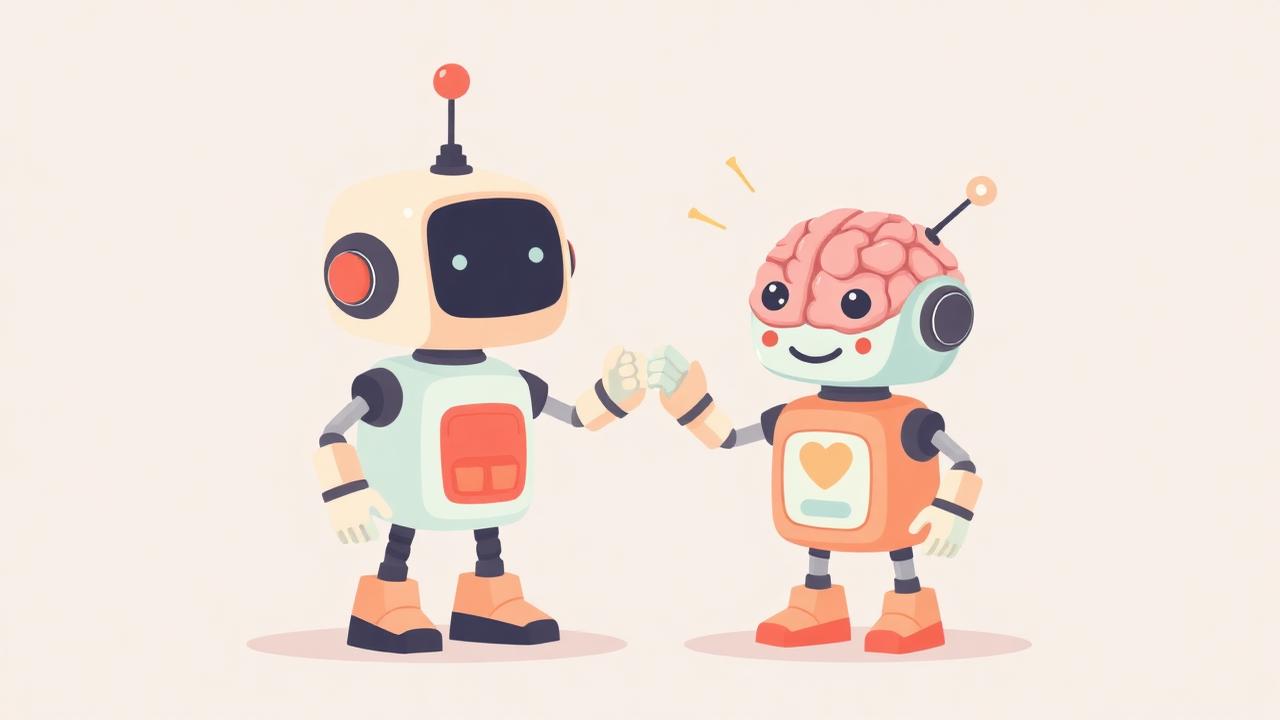
Robot and brain fist bump
Brains vs. Machines

What today's neuroscience and AI research actually compare

The human brain and large AI models solve similar problems with very different architectures. Knowing where each excels - and fails - is one of the most useful literacies of the decade.

The adult human brain contains roughly 86 billion neurons (Azevedo et al., Journal of Comparative Neurology, 2009) and runs on about 20 watts - roughly the power of a dim lightbulb. A frontier large language model can have hundreds of billions of parameters but requires megawatts of data-center power to train and orders of magnitude more energy per inference than a single human thought.

Where AI clearly wins: pattern recognition over enormous datasets, exhaustive search, recall of indexed information, and statistical consistency. Where humans still dominate: causal reasoning about novel situations, embodied common sense, robust moral judgment, learning a new skill from a handful of examples (few-shot learning in the truest sense), and genuine creative leaps. MIT CSAIL and Stanford HAI publish annual benchmarks tracking exactly which tasks have crossed the human-parity line and which remain open.

The Stanford AI Index Report (2024) shows AI now outperforms humans on image classification, basic reading comprehension, and visual reasoning, while humans still lead on competition-level mathematics, multi-step planning, and complex visual common-sense. Critically, AI systems can be confidently wrong (hallucination), and uncertainty calibration remains an unsolved problem.

Neuroscientists at the Allen Institute for Brain Science and DeepMind have noted that human brains learn from sparse, multi-modal, embodied experience - exactly the regime where current AI is weakest. This is why your two-year-old can generalize 'cup' after seeing three of them, while a vision model may need millions of labeled examples.

Key research findings

  • The adult brain has ~86 billion neurons.

    Source: Azevedo et al. - Journal of Comparative Neurology (2009)

  • AI has reached or exceeded human performance on image classification and basic reading comprehension; humans lead on advanced math, planning, and visual common-sense.

    Source: Stanford HAI - AI Index Report (2024)

  • Humans learn novel concepts from sparse examples; current AI systems require orders of magnitude more data.

    Source: Lake, Salakhutdinov & Tenenbaum - Science (2015)

Frequently asked questions

Is the brain a computer?+

It is a useful metaphor and a misleading one. Brains compute, but they also feel, regulate a body, and learn through embodied action - none of which current computers do. Most computational neuroscientists describe the brain as a biological learning system, not a digital one.

Will AI think exactly like a human?+

There is no scientific consensus, but most researchers - including Stuart Russell (UC Berkeley) and Yoshua Bengio (Mila / Université de Montréal) - argue that current architectures lack key human capabilities (causal models, grounded common sense, embodiment) and that crossing those gaps will likely require new approaches, not just more scale.

Should I worry AI will replace human creativity?+

AI is best understood as a powerful collaborator. The Harvard Business Review and MIT Sloan have both documented that human + AI teams outperform either alone in knowledge work tasks. The literacy that matters is knowing when to trust each.