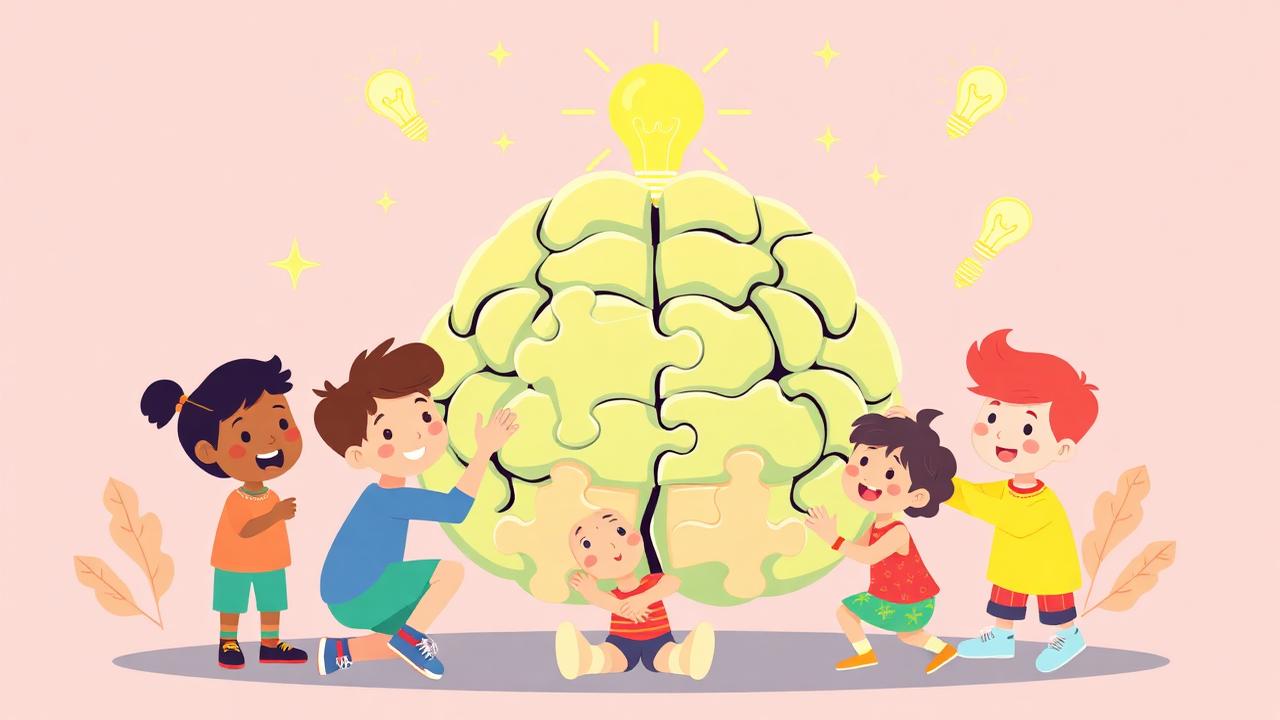
The deep neuroscience of why well-designed brainteases build children’s minds - citing Harvard, the AAP, NIH, Mayo Clinic, Karolinska Institutet, UCSF, Stanford and the University of Geneva.
A child’s brain is the most plastic it will ever be. Short, joyful sessions of well-designed brainteases - 10 to 20 minutes a day - strengthen the exact circuits (working memory, attention, executive function) that determine how well kids learn, regulate their feelings, and bounce back from setbacks. The research is consistent across Harvard, the NIH, Karolinska Institutet, UCSF and the University of Geneva: use it to grow it. And the most powerful ingredient - confirmed by Stanford’s Carol Dweck - is that kids actually enjoy it. Fun is the mechanism.
Eight things brainteases build in a kid’s brain
Each claim below links to its primary source - peer-reviewed paper, hospital patient-education page, or institute research summary.
Stronger working memory
Working memory is the mental scratchpad kids use to hold a teacher’s instructions, follow a recipe, or keep numbers in mind while solving a math problem.
Randomized trials of computerized working-memory training in children - pioneered by Torkel Klingberg’s lab - show measurable improvements in digit span and parent-rated attention, especially in kids with ADHD. The brain regions involved (dorsolateral prefrontal cortex and parietal cortex) are still developing well into the teen years, which is why training during childhood is so productive.
Sustained attention - the ability to ignore a buzzing phone, a chatty classmate, a tempting daydream - is one of the strongest single predictors of school success.
Daphne Bavelier’s lab at the University of Geneva has shown across two decades of studies that the right kind of fast, rule-based games measurably improve visual attention, the ability to track multiple objects, and decision speed. The classic Nature paper showed action gamers can monitor about 30% more visual items at once than non-gamers.
Executive function - the brain’s air-traffic controller
Executive function bundles working memory, mental flexibility, and self-control. It is what lets a child plan a science project, switch from drawing to homework without a meltdown, and resist a second cookie.
The Harvard Center on the Developing Child calls executive function ‘the most important mental skills for learning.’ Its development is plastic - it can be strengthened through deliberate practice on rule-switching, inhibition, and updating tasks, which is exactly what most brainteases are.
Confident kids try harder problems. Kids who try harder problems get smarter. That loop is built - or broken - early.
Carol Dweck’s growth-mindset research at Stanford shows children praised for effort (not innate cleverness) take on tougher challenges and recover faster from failure. BrainTeases are perfect for this - they’re hard enough to feel like a real win, short enough that a kid can fail safely and try again.
Losing a round, getting a puzzle wrong, restarting after a streak breaks - brain games give kids low-stakes practice in handling frustration.
Adele Diamond’s research at UBC links executive-function training to better emotional self-regulation in children. The same prefrontal circuits that help a child hold a rule in mind also help them pause before reacting - a foundation for both classroom behavior and lifelong mental health.
Recognising patterns - in numbers, in letters, in stories - is a foundational skill behind both arithmetic fluency and reading comprehension.
Mayo Clinic and Harvard Health both note that mentally stimulating activities (puzzles, reading, learning new skills) are among the most evidence-backed ways to keep neural circuits efficient. The same principle that protects older brains builds them in children: use it to grow it.
Cognitive reserve is the brain’s buffer - the extra capacity that helps it stay sharp despite stress, illness, or aging. It is built up over a lifetime, and childhood is when the foundation is poured.
The National Institute on Aging summarizes the ACTIVE trial and decades of follow-up work: people who engaged in cognitively stimulating activities throughout life showed slower decline. The earlier the habit starts, the deeper the reserve.
When kids play brain games together - taking turns, explaining strategies, narrating their thinking - they practice the language of reasoning out loud.
Cleveland Clinic and the AAP both emphasise that co-viewing and co-playing turn screen time into a social, language-rich activity. Kids who talk through puzzles with a parent or sibling build vocabulary and theory-of-mind alongside the cognitive skill itself.
How much, how often - the AAP-aligned rule of thumb
Ages 4–6
5–10 min/day
Co-play with a grown-up. Pattern, memory and matching.
Ages 7–10
10–15 min/day
Add logic, attention, and visual puzzles. Aim for variety.
Ages 11+
15–20 min/day
Mix lateral thinking, working memory, and timed challenges.
The American Academy of Pediatrics emphasises consistent limits and quality over quantity. Brain games should sit alongside sleep, daily physical activity, reading aloud, and unstructured play - not replace them. AAP - Media and Children →
Where to start on BrainTeases.com
Every challenge on the site is free, requires no signup, and is built on the science above. Try a category that fits your child’s age and stretch from there.
Well-designed brainteases reliably improve the specific skills they train - working memory, attention, processing speed and visual reasoning - and those skills underpin classroom learning. The honest scientific consensus (a 2014 Stanford / Max Planck consensus letter, reaffirmed by the National Institute on Aging) is that gains are real but often domain-specific. So brain games make kids stronger at the cognitive muscles they train; transfer is biggest when those muscles are also being used in school and life.
How long should a child play brain games per day?+
The American Academy of Pediatrics recommends consistent screen-time limits and quality over quantity. For most school-age kids, 10–20 minutes of focused brain games a day - paired with sleep, exercise, reading, and free play - is plenty.
What age is best to start?+
Executive function develops fastest between ages 3–5 and again in adolescence, per the Harvard Center on the Developing Child. Simple memory and pattern games suit kids from around age 4–5; harder logic and lateral puzzles suit 7+.
Are these games better than action video games?+
They train different things. Bavelier-lab research shows action games sharpen visual attention; structured brainteases train the executive functions used most in school. A balanced mix, time-limited, gives the broadest benefit.
Can brain games help kids with ADHD?+
Computerized working-memory training (studied since the early 2000s at Karolinska Institutet) shows real gains in working memory and parent-rated attention for children with ADHD. Brain games are a complement to - not a replacement for - evidence-based ADHD care.
Why does making it fun matter?+
Fun is the mechanism, not a bonus. Dopamine released during play strengthens the very connections being trained, and Carol Dweck’s growth-mindset research shows that enjoyable challenge builds the confidence kids need to attempt harder problems voluntarily.
Sources & credits
Every fact above traces back to a named author at a named institution. If a link breaks, the citation still holds - the journal, year and authors are enough to find the work.
1. Klingberg, T., Fernell, E., Olesen, P. J. et al. - Karolinska Institutet, Stockholm
“Computerized training of working memory in children with ADHD - a randomized, controlled trial.” J Am Acad Child Adolesc Psychiatry, 44(2): 177–186 (2005).
Editorial note: BrainTeases.com is an educational resource, not a medical provider. Content is reviewed against our Editorial Standards and Citation Policy. For diagnosis or treatment of any neurological or developmental condition, consult a licensed clinician.
Ten minutes today. A stronger brain tomorrow.
Pick a category, set a timer, and play together. The science is on your side.